
Focus Man: We Weren’t Lost
Chapter 6
It had started later than it should have, although three o'clock in the afternoon did not seem late when you were a boy and summer afternoons appeared to contain considerably more hours than clocks suggested.
The hills were right there behind the neighborhood. They were not wilderness, at least not in the way Focus Man understood wilderness then. Wilderness was someplace adults drove to with camping equipment. These were simply the hills—the dry slopes rising above the houses, crossed by trails and firebreaks and familiar enough to feel like another part of the neighborhood.
He and Tim had been up there before.
Tim was a few years younger, though differences in age among boys tended to matter less once they were away from adults. Focus Man was old enough to be the one expected to know what he was doing and young enough not to give that responsibility much thought.
They followed the firebreak upward.
It ran along the spine of the hills, wider than the smaller trails that crossed the slopes below and steep enough in places that they had to lean forward and work for every step. The late-afternoon sun was still warm. Dust rose around their shoes. Dry brush crowded the edges of the break, and the chaparral gave off that peculiar smell of Southern California hills in summer—dust and sage and sun-baked leaves.
They climbed farther than they had before.
There was no decision to do so. No destination had been chosen. One rise led naturally to another, and each time they reached what appeared from below to be the top, the firebreak continued.
From the ridge they could see nearly everything that mattered.
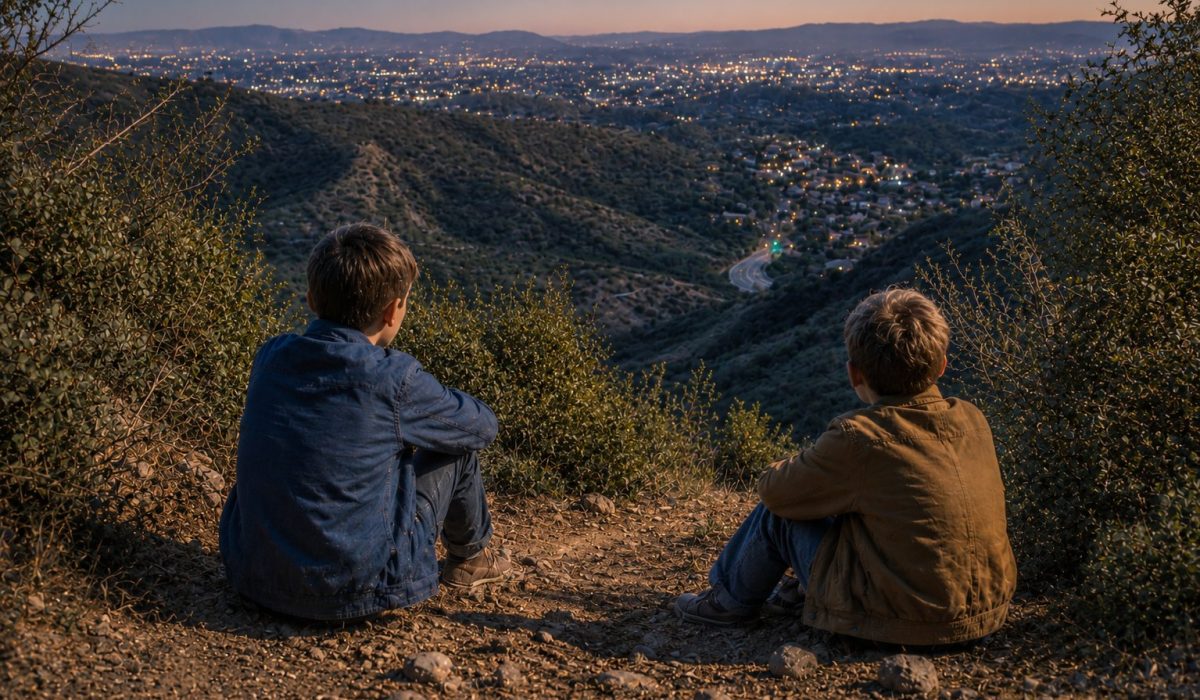
Their neighborhood lay below them in neat arrangements of streets and rooftops. There was the bridge over the flood-control channel and, beyond it, La Crescenta Boulevard. They could even see the traffic signal changing at the intersection.
Red.
Green.
Red again.
Home seemed close from up there.
That was part of the deception of elevation. Distance flattened when you looked down on it. Streets that required fifteen minutes to walk seemed separated by only a few inches. Houses became objects you could almost reach out and move with your hand.
It seemed impossible to get into much trouble while you could still see where you lived.
The afternoon changed before either boy paid much attention to it. The sun dropped behind the ridge across the canyon, taking the warmth with it. Shadows stretched across the slopes. The bright certainty of the afternoon softened into something cooler and less forgiving.
Tim was the first to say they should go back.
There was nothing difficult about that. All they had to do was turn around and follow the firebreak the way they had come. It would take a while, but every step of it was known.
Then they looked down the hillside.
There were openings in the brush below them, narrow strips of exposed ground that appeared to lead almost directly toward the neighborhood.
The firebreak went around.
Those went down.
To a boy, this was persuasive geometry.
Focus Man suggested the shortcut.
For the first part of the descent, his reasoning appeared to have been excellent. The slope was steep but manageable, and they made considerably faster progress than they would have on the firebreak. Loose dirt slid beneath their shoes, sometimes carrying them several feet farther than intended, but that merely added interest to the descent.
Then the openings began disappearing.
What had looked from above like a continuous route was nothing of the kind. One patch of exposed ground ended in chaparral. Another narrowed until branches closed over it completely. The brush grew higher and denser as they descended, and soon they were choosing each step according to where it was possible to put a foot rather than where they actually wanted to go.
Eventually they stopped.
Above them was the route they had come down, although it no longer looked like a route. Climbing back would mean fighting uphill through the same brush they had just pushed through, only now with gravity working against them.
Below was home.
They could see it.
The difficulty was the hillside between here and there.
They tried moving sideways. That wasn't much better. The ground was steep enough now that a misplaced foot could send a boy sliding into brush he couldn't see through. Daylight was going quickly.
They had managed to put themselves in a peculiar situation.
They knew precisely where they were.
They simply couldn't go anywhere.
They found a narrow ledge on the hillside where they could sit without sliding farther down. It was not a place anyone would have chosen to spend the night. But choosing had largely ceased to be part of the evening.
Darkness came.
The neighborhood below them began to light itself one house at a time.
That was what Focus Man remembered most clearly many years later. Not fear, exactly. Not even the hillside itself. He remembered the lights.
Kitchen windows came on. Porch lights appeared. Cars moved along streets he knew. From their ledge above the neighborhood, he and Tim watched the ordinary machinery of evening continue without them.
And always there was the traffic signal at the bridge.
Red.
Green.
Red.
Cars stopped, waited, and continued home.
It was strange to be close enough to see something so ordinary and too far away to participate in it. People down there were eating dinner. Televisions were being turned on. Parents were calling children inside. Somewhere his own family would by now have noticed that he hadn't come home.
The temperature dropped steadily.
Focus Man had a jacket and a cap with ear flaps. Tim was dressed less warmly, another fact that seemed to add itself to Focus Man's responsibility for the evening.
They shifted positions occasionally, trying to find some arrangement of dirt, rock, and brush that qualified as comfortable.
There wasn't one.
Tim had opinions about how they had arrived there.
Some of those opinions concerned Focus Man.
The older boy.
The one who had suggested the shortcut.
Focus Man did not argue. There are circumstances in which defending one's reasoning serves no useful purpose, and sitting on a hillside after dark because of that reasoning is one of them.
At some point he told Tim they weren't lost.
He meant it.
The firebreak was above them. The neighborhood was below. The bridge remained visible. The traffic signal continued faithfully changing colors as if to confirm their location.
They weren't lost.
They were stuck.
Focus Man considered this an important distinction.
Tim may have considered it less important.
The night stretched.
There was no dinner. There was very little sleep. Mostly there was cold and waiting and the growing awareness that morning was a surprisingly long way from evening.
Sometime during the night they heard voices.
At first the sound was so faint it might have been imagined. Then it came again from somewhere along the hills.
People calling.
They listened.
Another voice answered from farther away.
People were looking for them.
For reasons that made sense to boys sitting on a hillside and perhaps to nobody else, they didn't immediately answer. The searchers seemed far away. It was difficult to know exactly where the voices were coming from, and shouting into darkness felt somehow less useful than it undoubtedly was.
So the search continued.
The boys waited.
Below them, the traffic signal kept changing.
Eventually the darkness began to thin.
The hills returned gradually. First there were shapes where there had been only blackness. Then individual bushes appeared. The ground beneath them became ground again rather than something inferred from touch.
What had seemed impossible at night now merely looked difficult.
That was enough.
They began working their way downhill.
There was no trail. They made one by moving through whatever openings the hillside offered. Branches caught their clothing. Dry brush scratched their arms. Loose soil gave way beneath their feet, and occasionally they had to sit and slide before finding another place to stand.
But they were moving.
That alone changed everything.
The slope gradually eased. The brush opened. Ahead were the old horse corrals at Camp Max Straus.
Level ground.
After the night on the hillside, level ground seemed like a considerable achievement.
Then they heard voices again.
This time they were close.
The Sheriff's Posse was searching nearby.
Focus Man and Tim stepped into the open.
From that point onward, events no longer seemed to belong entirely to them.
Adults appeared. Questions came from several directions. Relief expressed itself as concern, excitement, reprimand, and embraces, sometimes in rapid succession. They were taken home. Other adults arrived. The story traveled faster than the boys did.
And then came the newspaper.
Their picture appeared on the front page.
BOYS FOUND.
Focus Man studied the headline.
Found seemed an odd choice.
They hadn't been wandering through the mountains without knowing where they were. They hadn't needed anyone to point toward home. For most of the night they had been able to see the traffic signal at the bottom of the hill.
They had known exactly where they were.
Unfortunately, BOYS WHO KNEW PRECISELY WHERE THEY WERE BUT COULDN'T GET THERE lacked something as a headline.
Television reporters came too.
Questions were asked. Cameras appeared. Adults reconstructed the adventure. With each retelling, Focus Man noticed that the story seemed to improve.
This interested him.
The actual account was fairly simple. Two boys had gone hiking too late in the afternoon. They had taken a shortcut. The shortcut had turned out not to be a shortcut. Darkness arrived. They spent the night on a hillside and walked down in the morning.
Apparently this was insufficient.
Somewhere along the way an owl entered the story.
Focus Man did not remember an owl.
There was also a slingshot.
He had no meaningful recollection of the slingshot either.
Most impressive was a quotation attributed to him.
He couldn't remember saying it.
He read it again.
It certainly sounded like something a boy in a newspaper story might say.
Whether it sounded like something he might say appeared to be a separate question.
He never corrected anybody. By then the story had acquired a life of its own, and the adults seemed pleased with it.
But something small had changed for Focus Man.
Until then, newspapers had belonged to the same general category as encyclopedias and schoolbooks. If something appeared in print, somebody had presumably checked it.
Now he possessed information unavailable to most newspaper readers.
He had been there.
And parts of it weren't true.
This was an unexpectedly useful education for a boy.
Decades later, he could no longer remember the reporter's name. He couldn't remember exactly what the newspaper claimed the owl had done or why the slingshot had become important. Even the invented quotation eventually disappeared from memory.
His skepticism did not.
The newspaper had unwittingly provided him with a lesson he carried for the rest of his life: there could be a considerable distance between what happened and what was reported to have happened.
He didn't need to make more of it than that.
What remained most clearly was still the hillside.
The cold.
Tim beside him.
The neighborhood spread below them while they waited for daylight.
And that traffic signal at the bridge, changing patiently through the entire night.
Red.
Green.
Red.
For all the years that followed, Focus Man never changed his mind about the central fact of the story.
The newspaper could call them whatever it wanted.
They weren't lost.
Posted in focus-man by Geoff Stevens