Retirement
For most of our working lives, the question “What do you do?” has a fairly simple answer.
We name our occupation.
We are teachers, accountants, mechanics, nurses, managers, programmers, farmers, or salespeople. The answer may not describe everything we are, but it gives us a place in the world. It tells other people—and sometimes reminds us—where we belong.
Then retirement arrives, and that familiar answer no longer seems to fit.
At first, retirement may feel like taking off a hat we have worn for a very long time. The hat may have become faded and misshapen. We may have complained about it, dreamed of replacing it, and counted the days until we could finally set it aside.
But once it is gone, we sometimes discover that it carried more than a job title. It carried routine, responsibility, identity, and a reason to get up in the morning.
Retirement gives us freedom, but freedom presents its own question:
Now what?
For me, the answer did not come all at once.
It arrived one hat at a time.
The Hats Began to Accumulate
I did not enter retirement with a grand plan to become all the things I am doing today.
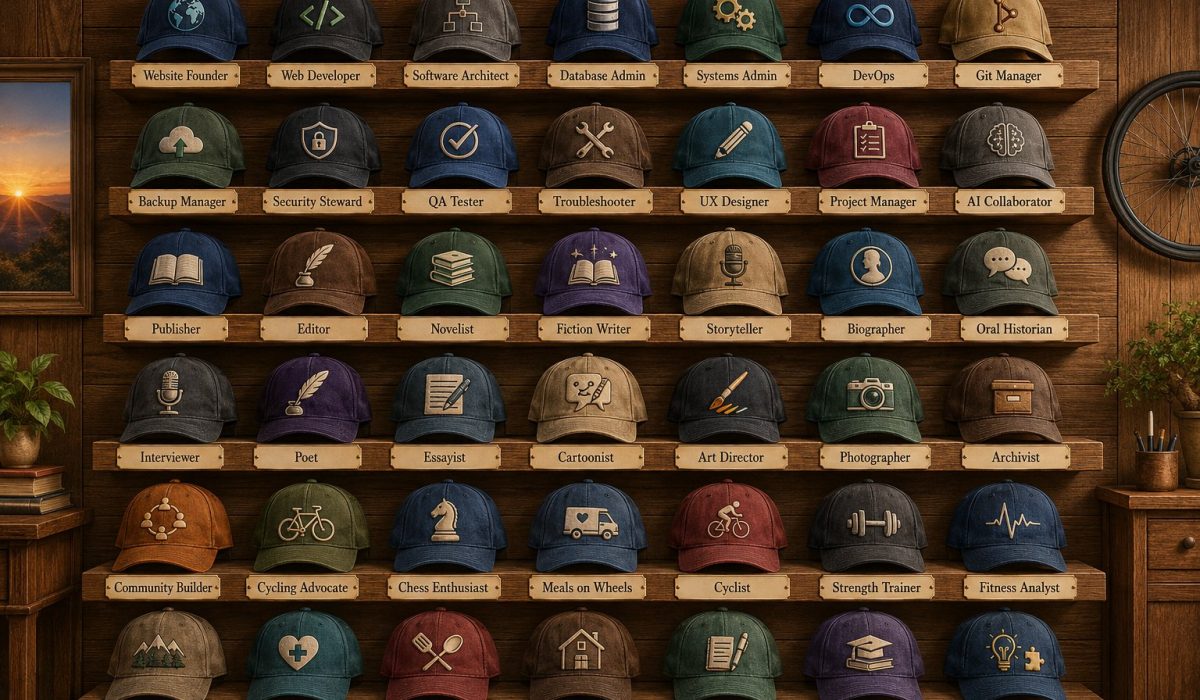
I did not sit down with a calendar and decide that I would become a website developer, novelist, cartoonist, interviewer, community organizer, cyclist, chess enthusiast, and Meals on Wheels volunteer.
One interest simply led to another.
A website needed to be built, so I became a developer.
The website needed a database, so I became a database designer and administrator. It needed security, backups, testing, and maintenance, so I became a systems administrator, troubleshooter, quality-assurance tester, and privacy steward.
People had stories worth preserving, so I became an interviewer.
Recorded conversations needed to be transcribed, organized, and shaped into something another person could read, so I became an editor, oral historian, biographer, and storyteller.
Ideas began arriving that did not belong to anyone’s actual life, so I became a novelist.
Cyclists provided an endless supply of wonderfully exaggerated behavior, so I became a cartoonist—or at least the person standing behind the cartoon, imagining the scene, arranging the characters, and deciding where the joke should land.
There were poems, essays, photographs, bicycle stories, community resources, and reflections about aging and living well.
Before long, one hat had become an entire wall of them.
Some Hats Are Serious
Several of my retirement hats come with real responsibilities.
When people create accounts on a website, share photographs, send private messages, or tell personal stories, someone must protect that information. When a person trusts me with memories from a difficult life, I have a responsibility to handle those memories carefully. When I publish information about a cycling group, a local business, or a community event, I want it to be accurate and fair.
These activities may not produce a paycheck, but they are still work.
That distinction has become important to me.
We sometimes assume that work performed without pay is merely a hobby. But purpose is not measured by income. A volunteer delivering meals is doing meaningful work. A grandparent caring for a child is doing meaningful work. A person recording the memories of an older neighbor is doing meaningful work.
Retirement did not mean that I stopped working.
It meant that I gained more freedom to choose the work I considered worth doing.
Some Hats Are Playful
Other hats exist largely because they make life more enjoyable.
I ride bicycles.
I play chess.
I take photographs.
I write stories and imagine characters whose lives can go in directions mine never did. I create cartoons about cyclists stuffing their jersey pockets at rest stops, climbing impossible hills, surviving crashes, and taking themselves far too seriously.
Play is not the opposite of purpose.
A bicycle ride can strengthen a friendship, preserve health, provide an adventure, or inspire a story. A chess game can exercise the mind while bringing people of different ages together. A humorous cartoon can help us recognize our own absurdities and laugh at them.
Some activities do not need to accomplish anything beyond making the day richer.
That is reason enough to keep them.
The Hats Do Not Always Fit Perfectly
Of course, wearing many hats creates its own problems.
There are always more stories to write, improvements to make, people to contact, rides to organize, files to back up, and ideas waiting for attention. A project that begins as a small improvement can uncover ten more things that need to be done.
Even in retirement, there are only so many hours in a day.
I sometimes need to remind myself that I am no longer working for an employer who expects every item to be completed by Friday afternoon. Not every problem is urgent. Not every idea must become a project. Not every project must be finished immediately.
A rewarding retirement can become an exhausting one if every interest turns into an obligation.
The hats are supposed to provide possibilities, not become another row of supervisors.
Part of living intentionally is deciding which hat deserves to be worn today—and which ones can remain on the shelf.
We Are Allowed to Be Beginners Again
One of the gifts of retirement is the opportunity to try things for which we have no formal qualifications.
We may hesitate to call ourselves writers because we have never published a book. We may resist the word “artist” because we have never attended art school. We may feel uncomfortable calling ourselves athletes because we will never stand on a podium.
But perhaps we have spent too much of life believing that titles must be awarded by someone else.
If you write, you are a writer.
If you make art, you are an artist.
If you interview people and preserve their memories, you are a storyteller.
If you train, challenge your body, and show up for the next ride, walk, swim, or workout, you are an athlete.
The purpose of a retirement hat is not to prove mastery. It gives us permission to participate.
Retirement allows us to become beginners again—not because we have forgotten everything we learned, but because we finally have room to discover something new.
Not Everyone Needs My Collection
A fulfilling retirement does not require forty different hats.
Some people may find deep satisfaction in only two or three: gardener, grandparent, reader. Others may travel, restore furniture, mentor younger people, care for animals, sing in a choir, help at a food bank, learn another language, or finally become the painter they once imagined they might be.
There is no correct collection.
The important question is not how many hats we wear. It is whether the ones we choose connect us with something beyond the passing of time.
A useful retirement may include several kinds of purpose:
-
Something that keeps the body moving
-
Something that challenges the mind
-
Something that allows creativity
-
Something that serves another person
-
Something that strengthens relationships
-
Something done simply for joy
One activity may satisfy several of these needs. A walking group provides exercise and friendship. Volunteering offers service and connection. Gardening combines movement, creativity, patience, and nourishment.
We do not need to fill every hour. We need enough reasons to care about the hours we have.
A Life Still Being Built
The word retirement can sound final, as though we have reached the last page of the useful part of life.
My experience has been different.
Retirement removed one title, but it made room for many others.
Some of my hats came from abilities developed during my working years. Some grew from interests I had never had time to pursue. Others appeared because a person, a community, or a problem happened to be in front of me and I decided to respond.
Together, they have given shape to my days.
They have allowed me to create, serve, learn, move, laugh, and connect with other people. They have also shown me that purpose is not something we discover once and carry unchanged for the rest of our lives.
Purpose can be rebuilt.
It can be revised.
It can begin with something as small as delivering a meal, joining a ride, asking someone to tell us about their life, writing the first paragraph of a story, or learning how to do something we have never done before.
Retirement did not leave me without a role.
It gave me the freedom to choose many of them.
Each morning, I can look at the wall, consider the day ahead, and decide which hat I will wear.
Posted in community by Geoffrey Stevens