
Focus Man: The Empty Chair
Chapter 31
For several days after visiting his mother, Focus Man found himself thinking about the quiet in her house.
It wasn't that she seemed lonely. He wasn't even sure she was. She had friends, neighbors, former coworkers, children and stepchildren scattered across various parts of the country, and a telephone that seemed to ring often enough. She had spent enough of her life surrounded by other people's needs that there might be something pleasant about deciding for herself when the television came on and what time dinner happened. Still, he remembered sitting with her in the living room and hearing the clock.
Nine children had once passed through that house, along with their friends, dates, arguments, music, schoolbooks, wet towels, baseball gloves and an astonishing amount of food. As a teenager he had stood in front of the open refrigerator looking for something to eat while his mother reminded him that staring at food did not cause new food to appear. Now, when neither of them spoke, he could hear the clock from across the room. He had noticed that during his visit without saying anything about it, and he continued to hear it in his mind after he and Claire were home.
Their house overlooking the Bay had never been noisy in the way his mother's had been. There had been dinners with friends, occasional parties and visitors who stayed for a weekend, but mostly it had belonged to the two of them. Over the years they had grown good at living in it together. Claire knew which mornings he wanted to be left alone with his coffee and whatever problem had occupied his mind before breakfast. He knew when she came home from work carrying a story that needed to be heard rather than repaired. She had finally stopped expecting him to remember where he had left his glasses, and he had finally stopped insisting that he always knew.
Usually they were on his head. Once they had been in the refrigerator.
Claire had found them beside the milk and stood in the kitchen holding them by one earpiece. “Would you like to explain this?”
He looked at the glasses, then at the open refrigerator. “I was probably carrying something.”
“Your glasses?”
“No. Something else.”
“What?”
He gave it some thought. “I don't remember.”
“That strengthens your argument considerably,” she said, and handed them over.
He had tried afterward to reconstruct the sequence. There must have been groceries, or something he had been reading, or an interruption that explained why he had opened the refrigerator while holding his glasses. He never found the missing step. The incident joined the private collection of stories they brought out whenever one of them required evidence of the other's habits.
So when Claire reminded him one Thursday morning that she wouldn't be home for dinner, he paid attention. At least he believed he did. She was meeting two women from work at a restaurant in the city to celebrate one of their promotions. He listened while pouring coffee, heard the name of the restaurant and the names of both women, and told her to have a good time when she said she would probably be late. She kissed him before leaving. By the time her car had backed out of the driveway, he was thinking about his own day.
That afternoon he stopped at the grocery store on the way home and bought salmon. He chose two pieces without considering why, then put them on the kitchen counter while he washed his hands and began preparing dinner. It was only when he took two plates from the cupboard that something in the arrangement troubled him. He stood with a plate in each hand, looking first at the salmon and then through the window toward the driveway. Claire's car wasn't there. For a moment he wondered if she had said she was working late; then the morning came back to him, including the names of the women and the restaurant.
“Right,” he said to the kitchen.
He returned one plate to the cupboard and put the second piece of salmon in the refrigerator, where, as far as he could tell, it encountered no personal belongings.
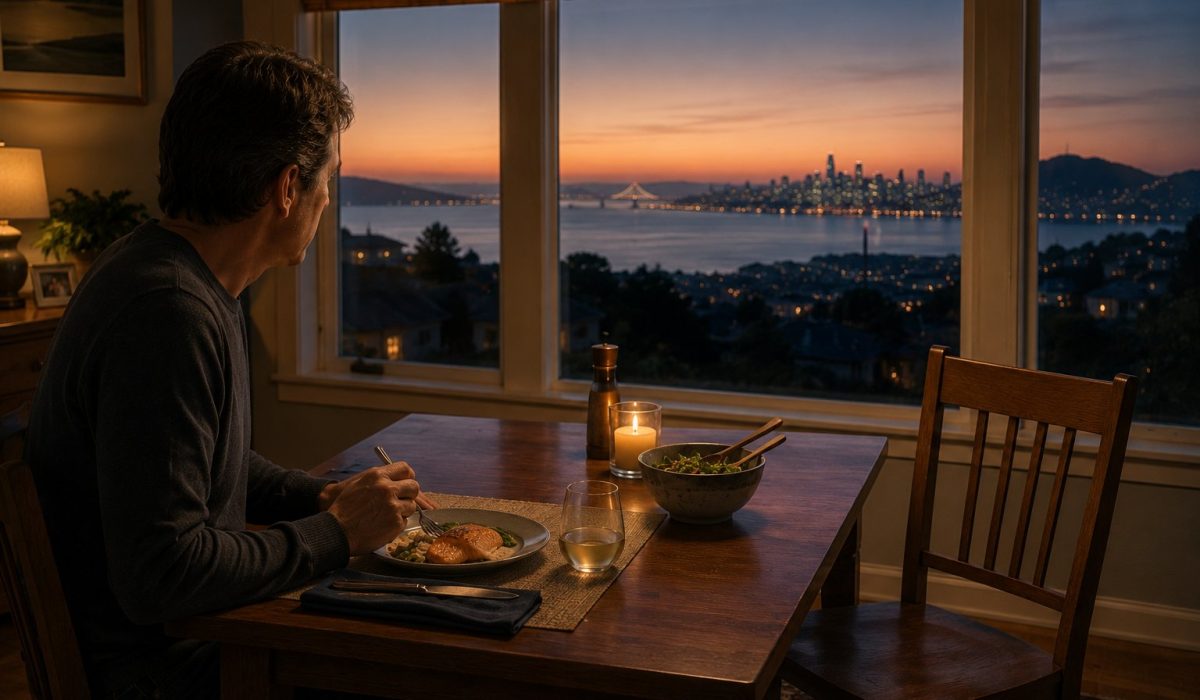
He ate at the dining table rather than in front of the television. That was habit more than principle. The table stood near the windows, and even after years in the house he found it difficult to sit there without looking out. The Bay was turning silver in the late afternoon light, and farther north the first lights were beginning to appear. An airplane descended toward the airport, moving so slowly from that distance that it seemed almost suspended over the water. Across from him was Claire's chair. He cut into his salmon and found it slightly overcooked; he had spent too long deciding what to do with the other piece.
There was nothing strange about eating alone. He had done it countless times before Claire entered his life and often enough since. Business trips, meetings, visits to friends, different schedules—two people could hardly spend years together without sometimes having dinner in different places. He turned on music Claire didn't particularly like and read part of the newspaper while he ate, a practice she considered evidence that civilization remained an unfinished project. He was having a pleasant evening. When he carried his plate into the kitchen, he considered putting it in the dishwasher at an angle just to annoy her, then set it properly in the rack. There was no one there to appreciate the gesture.
He made coffee, decided it was too late to drink it, and left the empty cup beside the sink. Ten minutes later he went looking for the coffee and was faintly disturbed to discover the cup without having any memory of deciding against it. The glasses in the refrigerator had been funny. This seemed less so, though he couldn't have said why. He put the cup away, took a book into the living room and settled where the lamp gave him enough light to read.
After a while he became aware of the sounds around him: the refrigerator cycling on in the kitchen, an occasional car outside, an airplane passing far overhead. He thought of his mother's clock. Her house had grown quiet in ways no one could have prevented. Children grew up and moved away. Her husband died. The rooms remained, but the people who had once filled them now came and went as visitors.
Claire would be home later. He knew where she was, and he hoped she was enjoying herself. Even so, his attention kept drifting from the page to the dining room. He returned to the book several times before admitting he had read the same paragraph often enough to recognize its shape without knowing what it said.
When he and Claire were first together, nearly everything they did seemed to enter a life they were making in common. A restaurant discovered by one became a restaurant known by both. A friend became our friend. They discussed a piece of furniture, bought it, carried it inside and decided where it belonged. Even their disagreements took place in that shared territory. In the years since, each of them had acquired parts of a life the other knew only by invitation. Claire had work that belonged to her and friendships he was glad she had. He had cycling friends and projects that held little interest for her. Neither needed to account for every hour away.
He valued that ease between them. He had watched other couples turn an evening apart into a test of devotion, and he was grateful that he and Claire could simply say where they were going and come home afterward. He picked up the book again, but before he found his place, his eyes went toward the chair at the table. The lamp reached only partway into the dining room. Beyond it, the windows reflected the darkening room.
Claire came home a little after ten. He heard her car, then the front door, and answered when she called his name. She appeared in the living room with a small white box.
“I brought you something.”
Inside was a piece of chocolate cake. He looked up at her. “You thought about me.”
“Briefly.”
“That's reassuring.”
She laughed and sat beside him, telling him about the woman whose promotion they had celebrated. She was delighted with the new position and terrified she wouldn't be good at it. Dinner had lasted longer than expected because they had ordered another bottle of wine and then dessert. Claire mentioned several people he knew and one he didn't, pausing to explain who she was. There had also been something involving a waiter and a dropped napkin. Claire laughed again while telling it, and although he suspected it had been funnier at the restaurant, he was pleased to hear her still enjoying it.
When she asked about his evening, he told her he had made salmon.
“Good?”
“One piece was.”
She turned toward him. He explained about the grocery store, the two plates and the salmon waiting in the refrigerator.
“You forgot I was going out.”
“I did not forget. I temporarily failed to incorporate available information.”
Claire studied him for a moment. “Is that what we're calling forgetting now?”
“It is more precise.”
“Of course it is.”
She leaned against him as he opened the cake. Neither wanted to get another plate, so they ate from the box and passed the fork back and forth. He told her about searching for coffee he had decided not to make.
“Eventually we're going to have to put a little tag on you,” she said.
“Like Mom's emergency button?”
“Exactly.”
“I'm not wearing it.”
“We'll tell you it's a watch.”
He laughed, and they finished the cake. Claire stayed beside him for a while, her head against his shoulder, then took the box to the kitchen before going upstairs. He heard water running in the bathroom and the muted sounds of drawers opening and closing.
Focus Man remained on the sofa. From there he could see the lights along the far shore, brighter now against the dark water. The windows had begun to reflect the room: the lamp beside him, the edge of the dining table, two chairs pushed beneath it. He thought of the second piece of salmon cooling in the refrigerator and of Claire bringing home the cake despite having spent the evening elsewhere. Upstairs, she moved from the bathroom into the bedroom.
He switched off the lamp and made his way across the room. Near the dining table he paused long enough to set one chair straight; it had been pulled a little farther out than the other. Then he went upstairs to Claire.
Posted in focus-man by Geoff Stevens